
31/07/2025

Police Oracle
AI to be used across prisons, probation and courts. Russell Webster reports.
The Ministry of Justice has today published its Artificial Intelligence Action Plan which it says sets out how tech will cut reoffending and make streets safe. The accompanying press release makes some bold claims, saying that:
“AI will be used across prisons, probation and courts to better track offenders and assess the risk they pose with tools that can predict violence behind bars, uncover secret messages sent by prisoners and connect offender records across different systems.”
Strategic priorities
The plan sets out the Ministry of Justice’s approach to “responsible and proportionate AI adoption” across courts, tribunals, prisons, probation and supporting services. Apparently, it has been developed in consultation with the independent judiciary and legal services regulators and will be implemented with the Home Office, the Crown Prosecution Service and trade unions. It will be interesting to see how the prison and probation unions react. If AI really can help workloads, then many will be pleased at some long overdue support, if it takes over key aspects of their job, then workers will not be so pleased. There are three strategi priorities:
Strengthen our foundations
This is described as enhancing AI leadership, governance, ethics, data, digital infrastructure and commercial frameworks. A dedicated Justice AI Unit led by a new Chief AI Officer will coordinate the delivery of the Plan.
Embed AI across the CJS
Priority areas include:
Reducing administrative burden with secure AI productivity tools including search, speech and document processing (e.g. transcription tools that allow probation officers to focus on higher-value work).
Increasing capacity through better scheduling (e.g. prison capacity).
Improving access to justice with citizen-facing assistants (e.g. enhancing case handling and service delivery in our call centres).
Enabling personalised education and rehabilitation (e.g. tailored training for our workforce and offenders).
Supporting better decisions through predictive and risk-assessment models (e.g. predicting the risk of violence in custody).
Invest in staff and partners
This priority is mainly couched in buzzwords and is hard to translate other than to say there will need to be a comprehensive staff training package and work across the CJS for new approaches to be effective.
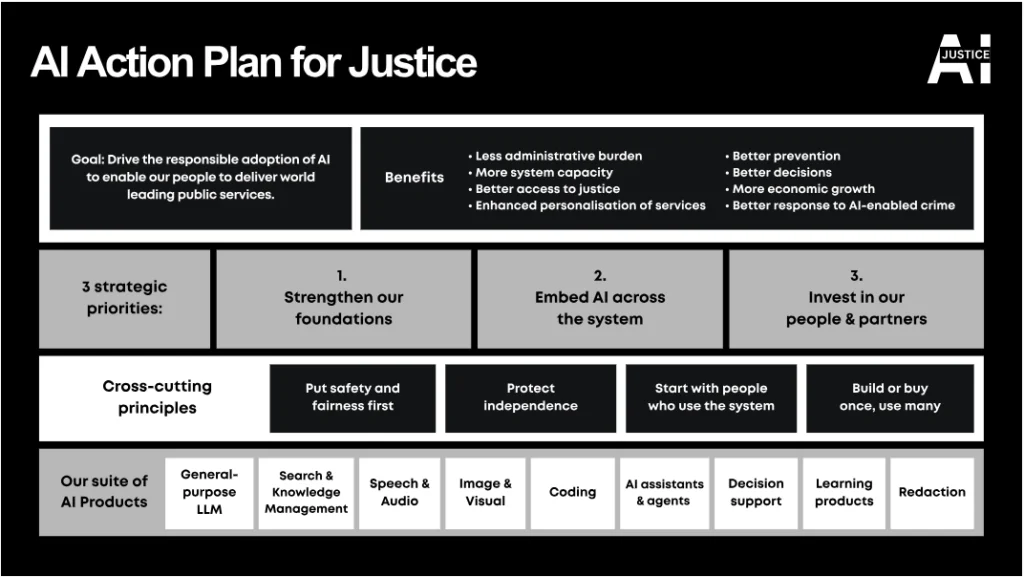
© Ministry of Justice 2025
First steps
In more practical terms, what can staff expect to change? Some of the work highlighted in the action plan includes:
Creating a single offender identify across the CJS so that, in theory, workers for any agency (police, probation, prison, CPS, courts) should be able to see records of all an individual’s contacts with the justice system. The new system uses Splink, open-source data linking software developed by MOJ data scientists which will apply explainable machine learning to deduplicate records and ensure accuracy.
Make AI productivity tools available to all staff across the CJS. Building on recent pilots, these tools are designed to support staff in a wide range of everyday tasks: from drafting emails and summarising documents to managing inboxes, redacting information, and generating reports.
There is an aspiration for both prison and probation staff to use AI-powered search to identify risk indicators or rehabilitation opportunities, and enable caseworkers “to swiftly locate relevant guidance or evidence, saving valuable time and improving decision-making“.
Conclusion
It is fair to say that the MoJ has been quicker than many expected in developing this approach to AI; it will be interesting to see how it will be rolled out and what impact it will have on the day to day lives of prison and probation staff and the offenders in their care.